The Playbook
Good fitness testimonials don't praise. They prove.
Most fitness testimonials sound nice but don't answer the doubt keeping a prospect from signing up. Here are stronger examples built around proof, hesitation, results, and real client language.
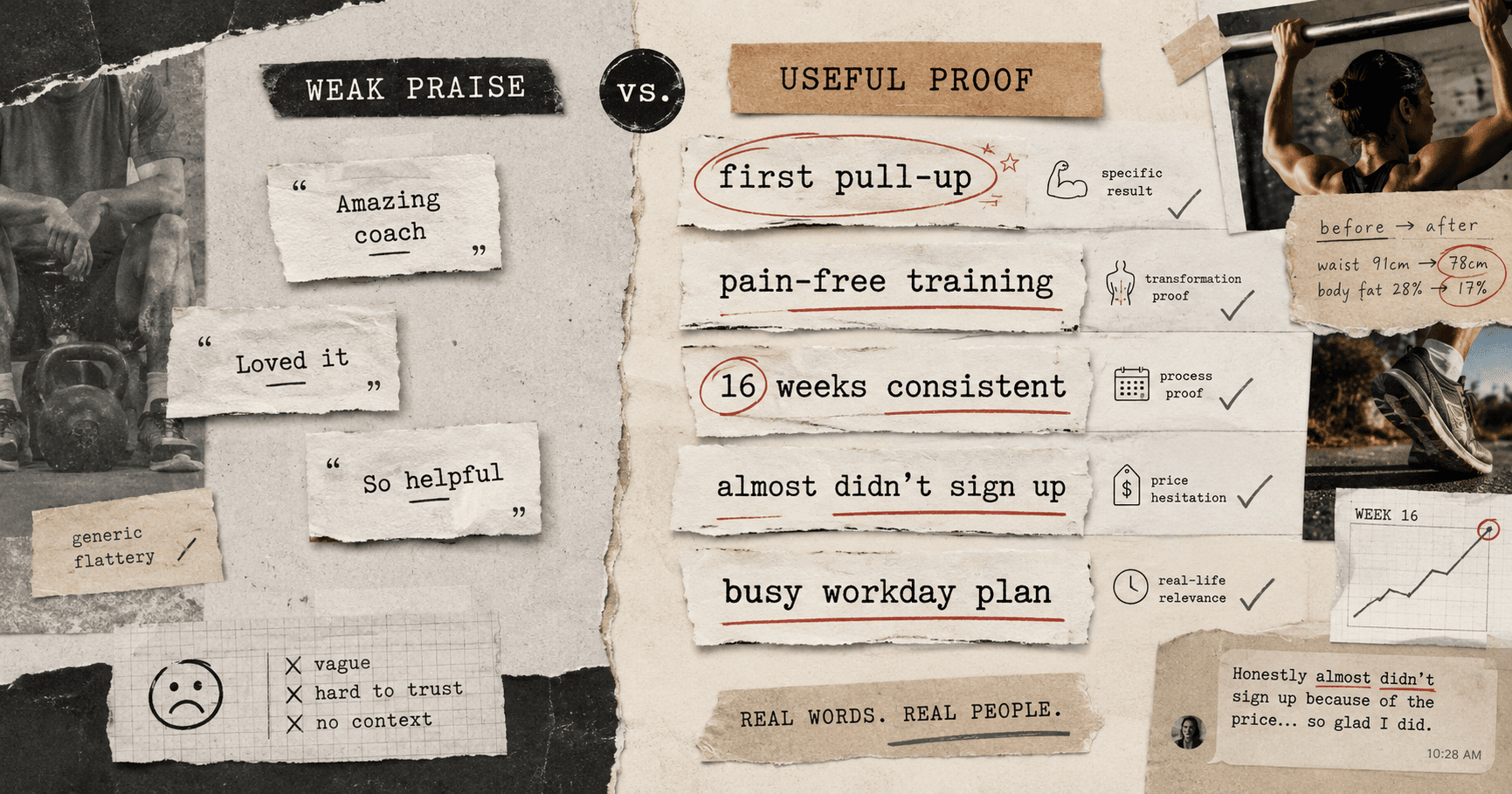
Fitness coaches don't need more glowing praise.
They need testimonials that answer the exact doubt keeping a prospect from signing up.
Most testimonial articles show a bunch of finished quotes but leave you with the same blank page.
That doesn't help if you're a fitness coach. You don't need another version of "Tina is amazing." You need to know why a testimonial works, what question pulled it out of the client, and where it belongs in your sales material.
The following examples are built for fitness coaches, personal trainers, and online coaches who need proof they can use. The best client testimonials aren't better written. They carry more context: the before state, the hesitation, the result, the process detail, or the real-life payoff.
Treat each testimonial like a piece of proof with a job. One quote might show transformation. Another might reduce price hesitation. Another might make online coaching feel less generic. The job matters because a nervous prospect is not reading for compliments. They're looking for evidence.
The five jobs a fitness testimonial can do
A good testimonial answers a doubt your next client already has.
Research from Senja found that specific, emotional testimonials perform 58% better than generic praise.
TestimonialStar reports that testimonials from customers with similar use cases show 83% stronger influence than generic endorsements. That tracks with Robert Cialdini's social proof work: "similar others" matter more than "impressive strangers."
In fitness, a prospect isn't only asking, "Did this work?" They're asking, "Will this work for someone like me, with my body, schedule, injury history, and past failures?"
| Testimonial job | What it proves | Best placement | Trigger question |
|---|---|---|---|
| Show transformation | The client reached a concrete result | Sales page, homepage, nurture email | "What can you do now that you couldn't do 90 days ago?" |
| Reduce hesitation | The client had the same fear and started anyway | Consult follow-up, sales DMs, FAQ | "What almost stopped you from signing up?" |
| Make the process believable | The coaching felt doable, not punishing | Program page, onboarding sequence | "What surprised you about the process?" |
| Prove specificity | The result has numbers, milestones, or clear before-after contrast | Hero proof, ads, pricing block | "What specific numbers changed?" |
| Create identification | The prospect recognizes their own situation | Niche landing page, Instagram Story, email | "Who were you before this started?" |
A coach with 15 sorted testimonials has a stronger sales asset than a coach with 80 vague quotes.
Transformation story testimonials
Transformation testimonials are the ones most coaches think of first. They can work well, but only when they include more than the result.
The strongest fitness testimonials usually have four parts: before state, obstacle, result, and emotional payoff. Peter Nguyen Fitness and NerdFitness both use this pattern in real client stories. The client was stuck, had tried other things, hit a specific milestone, and felt different afterward.
These are illustrative patterns based on real client language. Use the question to collect the real version from your own clients.
Example 1: Pain-free training
"Before coaching, I couldn't get through a lower-body workout without my knee flaring up. Twelve weeks in, I finished a full leg session, walked home, and woke up the next day without pain. I don't feel scared of training anymore."
Why it works: It names a daily fear. The client can train without bracing for pain.
Question that produced it: "What can you do now that you avoided before we started?"
Where to use it: Injury-aware coaching page, consult follow-up, or sales email.
Weak version to avoid: "My knee feels better and training has been great."
Example 2: First pull-up
"I started because I wanted to feel strong, but I couldn't hang from the bar for more than a few seconds. Last week I got my first pull-up. My daughter saw it and asked if I could teach her."
Why it works: It turns a strength milestone into a personal moment.
Question that produced it: "What was the first result that made you feel different outside the gym?"
Where to use it: Instagram Story, short quote card, homepage proof section, or an email about performance goals.
Weak version to avoid: "I got stronger and feel more confident."
Example 3: Health marker improvement
"My doctor had been warning me about my cholesterol for two years. After four months of coaching, my numbers moved back into the normal range. The biggest change was that I finally had a plan I could repeat on busy workdays."
Why it works: Health markers are high-trust proof. It also shows coaching can work on busy weekdays.
Question that produced it: "What changed outside the mirror that you didn't expect?"
Where to use it: Sales page, consult follow-up, or non-scale wins email.
Weak version to avoid: "My health improved a lot."
Example 4: Consistency after restarting for years
"I'd been starting over every Monday for years. This is the first time I've trained three days a week for six months without disappearing for a month in the middle. I didn't need a harder plan. I needed one I could come back to."
Why it works: This speaks to the prospect who has failed before. It makes consistency the result.
Question that produced it: "What pattern changed for you this time?"
Where to use it: Objection section, online coaching page, or nurture email.
Weak version to avoid: "I stayed consistent and loved the program."
Example 5: Keeping up with kids
"I joined because I was tired of saying no when my kids wanted me to play. Last weekend we hiked for two hours, and I wasn't the one asking to stop. That felt bigger than any number on the scale."
Why it works: The result is specific and easy to picture. The emotion comes through without being stated.
Question that produced it: "Where did you notice the result in real life?"
Where to use it: Homepage, family-focused offer page, email, or a dedicated personal training testimonials section on your website.
Short quote testimonials for websites, ads, and DMs
Short testimonials work when they contain one recognizable situation and one concrete change.
For website sections, think in one-line proof. The quote should sit near a button, pricing block, application form, or Instagram caption without needing a full story.
| Placement | Ideal length | Job | Sample line |
|---|---|---|---|
| Homepage hero | 12-18 words | Fast identification | "I stopped restarting every Monday and trained for 16 straight weeks." |
| Pricing block | 15-25 words | Reduce hesitation | "I was nervous about the cost, but I finally stopped wasting money on plans I quit." |
| Instagram Story | 8-15 words | Show the win | "First pain-free run in two years today." |
| Sales DM | 20-35 words | Answer a private doubt | "She was worried online coaching would feel generic. Three months later, she says it feels more personal than her old in-person sessions." |
| Paid ad | 10-18 words | Create curiosity | "I didn't need motivation. I needed a plan that survived my work schedule." |
Paid testimonial ads work best with one line, not a full story. A paid ad doesn't need the whole client journey. It needs one line that sounds like the prospect's exact problem.
Weak short quote:
"Tina is the best."
Stronger short quote:
"For the first time in five years, I can train without worrying my back will flare up."
The second line sells because it carries a before state, a result, and a fear removed.
Objection-killer testimonials: the proof most coaches forget
An objection-killer testimonial comes from the client who nearly didn't sign up.
This is the proof many coaches never collect. The biggest visual transformation may impress people, but the client who says, "I was scared this would be another plan I'd quit," speaks to the prospect hovering over your application form.
Fitness objections aren't only about price. They're about embarrassment, body image, injury history, past failure, and trust. In high-trust services, social proof tends to matter most when the decision carries real emotional risk.
Example 6: "I had tried everything before"
"I almost didn't book because I'd tried personal trainers, meal plans, and tracking apps before. I knew how to start. I didn't know how to stay with it. This was the first time the plan changed with my life instead of making me feel like I failed again."
Why it works: The client names the buyer's fear: "What if this is another thing I quit?" Real fitness testimonial pages from Peter Nguyen Fitness, JS Elite Fitness, and NerdFitness use this tried-before arc often.
Question that produced it: "What had you tried before this, and why didn't it stick?"
Where to use it: Consult follow-up, sales page objections, or nurture email.
Example 7: "I thought I was too out of shape"
"I thought I needed to get fitter before hiring a coach, which sounds funny now. The first month was built around what I could do, not what I thought I should be able to do. That made me keep showing up."
Why it works: It removes the shame barrier.
Question that produced it: "What did you believe about yourself before you started?"
Where to use it: FAQ, application page, beginner-focused landing page, or Instagram caption.
Example 8: "I worried online coaching would feel generic"
"I was worried online coaching would be a spreadsheet and a few check-in messages. Instead, my plan changed when work got busy, when my sleep fell apart, and when my shoulder acted up. It felt more personal than the in-person training I had before."
Why it works: This answers the online coaching objection with lived detail.
Question that produced it: "What surprised you about how the coaching worked?"
Where to use it: Online coaching page, sales DMs, or consult follow-up.
Example 9: "I didn't want another meal plan I'd abandon"
"I didn't want a perfect meal plan. I've abandoned plenty of those. We started with breakfast and my late-night snacking, and that made the rest feel possible. I lost 14 pounds without feeling like I was in diet jail."
Why it works: It names the resistance and the small shift that made the result believable.
Question that produced it: "What made this nutrition approach easier to keep?"
Where to use it: Nutrition coaching page, sales email, or pricing section.
Example 10: "I thought strength training would make my injury worse"
"I avoided strength training because I thought it would make my back worse. We started slower than my ego wanted, and now I can deadlift, garden, and sit through a workday without the same fear. I wish I'd started earlier."
Why it works: The hesitation is specific. The result includes gym performance and ordinary life.
Question that produced it: "What did you feel nervous about before the first session?"
Where to use it: Injury-aware coaching page, consult follow-up, or testimonial section under "Is this right for me?"
Video testimonial examples that don't sound coached
Video testimonials work because prospects can hear the client thinking.
Use phone video. Give the client one prompt at a time. Zebracat reports that landing pages with video testimonials saw a 39% conversion lift compared with pages using only written reviews. The format is strong, but only if the answer still sounds human.
Example 11: The 45-second milestone video
Prompt:
"Tell me what you can do now that you couldn't do before we started."
A strong answer might sound like:
"When we started, I couldn't run for five minutes without stopping. Yesterday I ran my first 5K. I didn't think I was someone who could run, so this feels strange in the best way."
Use this for performance wins, pain-free movement, first races, pull-ups, PRs, and consistency streaks.
Example 12: The hesitation video
Prompt:
"What almost stopped you from signing up, and what would you tell someone with the same worry?"
A strong answer might sound like:
"I was embarrassed because I thought I was too far behind. I would tell someone not to wait until they feel ready. The whole point is that you start where you are."
Use this on application pages and consult follow-ups.
Example 13: The process video
Prompt:
"What did coaching feel like week to week?"
A strong answer might sound like:
"It felt practical. If travel got messy or my kid was sick, we adjusted instead of throwing the week away. That was the difference for me."
Use this when prospects worry your coaching will be rigid or too time-consuming.
Case study testimonials for bigger transformations
A case study testimonial works when the result needs context.
NerdFitness does this well with success stories that read like short narratives: obstacle, process, specific result, emotional payoff, and recommendation.
Use this format:
- Client context: Who were they before coaching?
- Obstacle: What had they tried, avoided, or believed?
- Coaching approach: What changed in the plan?
- Measurable result: What numbers, habits, or milestones changed?
- Client quote: What did they say in their own words?
- Takeaway: What should a similar prospect understand?
Illustrative (brief) case study testimonial:
"When Maya started, she had trained on and off for years but never made it past week four. Her goal wasn't a photo shoot. She wanted to finish a full 12-week strength block without quitting. We built a three-day plan around her work schedule, added two backup workouts for chaotic weeks, and tracked consistency before intensity. After 12 weeks, she had completed 34 of 36 planned sessions, added 55 pounds to her deadlift, and said, 'This is the first program that didn't make one missed day feel like failure.'"
This gives the reader enough context to understand why the result happened.
Screenshot testimonials: rough proof that feels real
Screenshots from your favorite messaging app aren't second-tier testimonials. For fitness coaches, they may be the most natural proof format.
The best client wins often arrive by text or DM before they become polished testimonials:
"My jeans fit again."
"I hit 100kg today."
"My husband asked what changed because I have more energy at night."
"First pain-free walk in months."
"I didn't miss a workout this week, even with travel."
"My sister asked for your info."
"Six months later and this is still how I eat."
That roughness is the signal.
Use screenshots when the client already said the useful thing. Don't ask them to rewrite it unless you need a longer case study. Ask for permission with the use case attached:
"This is such a good win. Would you be comfortable with me sharing this screenshot on Instagram Stories if I blur your name and photo?"
Or:
"Would you be open to me using this line on my website? I can use your first name only, blur anything private, or keep it anonymous."
Label the proof so people know what they're seeing:
- "First pain-free run after 10 weeks."
- "Client text after her first full month of travel-proof training."
- "Post-program check-in, six months later."
Privacy matters. Get specific permission and protect health details.
Good vs. poor testimonial examples
The stronger version isn't more polished. It's more specific.
| Weak testimonial | Why it falls flat | Stronger version | Question that gets it |
|---|---|---|---|
| "Tina is amazing." | Praise without proof | "Tina helped me stop skipping workouts every time work got busy." | "What changed in your weekly routine?" |
| "I lost weight and feel better." | No before state or context | "I lost 18 pounds after years of losing the same five pounds and gaining it back." | "What had happened before this program?" |
| "The program works." | Could apply to anything | "The backup workouts kept me consistent during three weeks of travel." | "What made the plan easier to follow?" |
| "I got stronger." | No milestone | "I went from bodyweight squats to deadlifting 155 pounds." | "What specific numbers changed?" |
| "Best decision ever." | Sounds generic and inflated | "I almost didn't sign up because of the price, but I spent more quitting cheaper plans." | "What almost stopped you from signing up?" |
| "She cares about her clients." | Nice, but vague | "When my shoulder flared up, she changed the plan the same day instead of making me push through." | "When did you feel supported during the process?" |
| "I feel confident now." | Emotional payoff without a scene | "I walked into the weights area alone for the first time and knew what to do." | "Where did you notice the confidence?" |
| "I would recommend this to anyone." | Too broad | "I'd recommend this to anyone who thinks they need to get fit before asking for help." | "Who would you recommend this to?" |
What makes a testimonial weak or strong?
A weak testimonial asks the reader to trust praise. A strong testimonial gives the reader evidence: the before state, hesitation, specific result, process detail, or real-life payoff.
How to collect testimonials like these this week
Don't wait for a testimonial campaign. Collect proof when the client gives you a reason.
Use this system:
-
Ask within 48 hours of a win. The details are still fresh. BrightLocal's 2026 consumer review research found that 74% of consumers only want reviews from the last three months, and 32% look for reviews from the last two weeks. Fresh proof matters.
-
Pick two or three questions. Don't send a client 12 prompts after they hit a PR. Ask the questions that match the proof you need.
-
Screenshot when they already said the useful thing. If the win came through text, ask permission to use the text. Don't turn a low-friction win into homework.
-
Use a form for fuller stories. For big milestones, send the full question set: before state, hesitation, result, numbers, surprise, recommendation.
-
Use video for bigger transformations. Ask for a short phone video with one prompt, not a polished speech.
-
Ask permission with the exact use case. Tell them where you want to use it, what name or image will appear, and what you'll blur or remove.
-
Tag proof by job. Sort testimonials into buckets: transformation, hesitation, process, specificity, identification, screenshot, case study.
Use this article as the example library. For the ask script, read The 7 questions to ask before a client win goes cold.
Build proof clients can answer and prospects can believe
Your job isn't to collect compliments.
Your job is to catch the specific client language that helps the next person recognize themselves and trust the process. That might be a case study, a 14-word website quote, a rough screenshot, or a video from someone who nearly didn't sign up.
The best testimonial isn't always the biggest transformation. It's often the one that answers the doubt your next client is embarrassed to say out loud.
Collect that proof. Sort it by the job it does. Then put it where a nervous prospect needs to see it.
Enjoyed this one?

Turn your next client win into proof that sells.
Make a share-ready card from a client win in under two minutes with The Receipt Printer. Free, no login. Or let your client tell the story with The Receipt Request.
Make a free card