The Playbook
The 7 questions to ask before a client win goes cold
Stop asking for generic testimonials. Ask these 7 post-win questions to capture effective client proof for testimonials, case studies, sales copy, and landing-page proof.
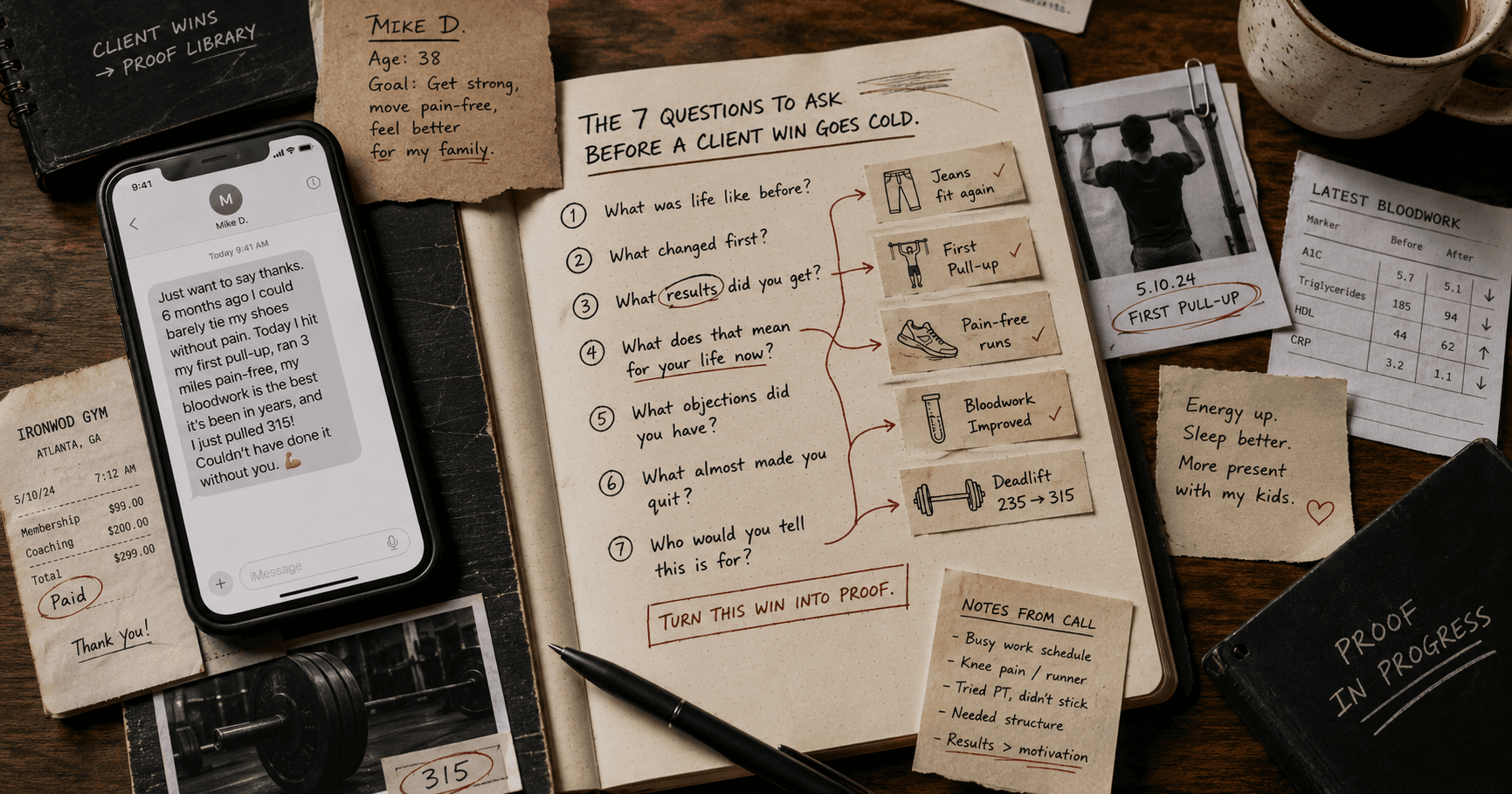
Your client won. The clock just started.
A client texts that she wore the jeans again. Someone gets their first pull-up, runs pain-free, adds 40 pounds to a deadlift, or sees bloodwork move in the right direction.
That's the moment.
If you're wondering how to ask for testimonials, start by not asking for a testimonial. Right after a win, your client can still remember the exact before, the nervous middle, and the tiny detail that makes the story believable. Wait two weeks and you may get, "Tina is amazing and so supportive."
Nice? Yes. Useful? Barely.
Fitness coaches don't need better compliments. They need better proof.
The pattern is uncomfortable: happy clients are often willing to help, but most proof still goes uncaptured unless the coach asks at the right moment. The real problem: when coaches do ask, they hand the client the wrong job.
The problem is the frame, not the client
"Would you write me a testimonial?" sounds small. For the client, it's not small.
You just asked them to become a copywriter, editor, strategist, and case study writer while standing in the gym parking lot with wet hair and a protein shaker leaking into their tote bag.
Most clients want to help. They just don't know what useful proof sounds like. So they guess. They write the safest compliment they can think of: "She is great." "I loved working with him." "The program changed my life."
The better question isn't "How do I make clients say nicer things?"
It's "How do I make the useful story easier to tell?"
A good post-win question gives the client one thing to answer. No performance. No blank page. No pressure to sound polished. Just a clean prompt while the result is still fresh.
Weak testimonial request vs. strong post-win questions
The difference is easy to spot once you see the requests side by side.
| Weak request | Strong post-win question |
|---|---|
| "Could you write me a testimonial?" | "What can you do now that you couldn't do 90 days ago?" |
| "Would you say a few nice words?" | "What almost stopped you from signing up?" |
| "Can you leave a review?" | "If your best friend asked if they should work with me, what would you tell them?" |
Weak request's result:
"Tina is amazing and so supportive."
Strong post-win result:
"Before this, I couldn't get through a lower-body workout without my knee flaring up. Last week I finished a full session, walked home, and woke up the next day without pain."
That second example is invented, but the pattern is real. Specific questions give you before-state, proof, emotion, and contrast. Generic requests give you warm mush in a nice font.
Northwestern's Spiegel Research Center found that displaying helpful reviews can sharply increase purchase likelihood, with the biggest lifts happening when buyers face more uncertainty. Those are not fitness-coaching studies, so treat them as directional evidence, not a promise. The point still holds: social proof works when it helps the next person see themselves in the result.
Why the first 48 hours matter
The 48-hour window is a rule of thumb, not a lab-tested timer.
Ask right after the win because four things are still intact.
- Memory: The client remembers the moment. The first pull-up. The pants button. The walk home without pain.
- Emotion: Their own words still have heat on them. Two weeks later, the story gets filed under "good experience."
- Specificity: Numbers, details, and before-and-after contrast are easier to recall.
- Attribution: The connection between your coaching and their result is still clear.
BrightLocal's 2026 consumer review research found that 74% of consumers only care about reviews from the last three months, and 32% look for reviews from the last two weeks. Prospects care about fresh proof. Clients also give better proof before work, dinner, school pickup, and whatever chaos attacked their inbox that day buries the win.
Ask these 7 questions after a client win
Use these after a clear milestone. You don't need all seven every time. For a quick text, pick two or three. For a case study, use the full set.
-
"What were you struggling with before we started working together?"
This pulls out the before state your next prospect recognizes. -
"What almost stopped you from signing up?"
This gives you the objection hiding under the polite consult-call answer. -
"What can you do now that you couldn't do 90 days ago?"
This turns the result into a lived outcome, not a vague transformation. -
"What surprised you most about the process?"
This often reveals what makes your coaching different. -
"If your best friend asked if they should work with me, what would you tell them?"
This gets natural recommendation language instead of formal testimonial voice. -
"What specific numbers changed?"
This captures weight, PRs, measurements, consistency, sleep, pain levels, energy, bloodwork, or anything else that makes the proof concrete. -
"Is there anything else you'd want other people to know?"
This leaves space for the line your framework missed.
One bonus question earns a permanent spot: "Why do you come?"
Important: this is the question that can quietly humble you. A coach may expect to hear "programming," "accountability," or "great coaching." Then a client says "community," "I feel included here," or "I come because this is the only place I don't feel judged." Tiny panic, huge insight. Better questions do more than collect compliments. They show you what people buy from you, which isn't always what you thought you were selling.
Match the ask to the moment
Not every win needs the same collection method. Match the ask to the size of the moment and the client's energy.
- Screenshot capture: Use this when the client already sent the win by text or DM. Ask, "Would you mind if I shared this?" This is the lowest-friction ask, because they already said the thing.
- Link method: Use this for a clear milestone. Send a short form within 48 hours, while the details are still easy to pull up. Expect more drop-off than a screenshot, but better structure and cleaner answers.
- Video ask: Use this for bigger transformations or sales-page proof. It takes more effort, so fewer clients will say yes, but the emotion and credibility can carry more weight.
The rule: don't make a client climb a mountain to help you document the hill they just climbed.
One post-win Q&A can become seven assets
Asking better questions gets you more than a nicer quote. It gives you raw material you can use across the business.
| Answer source | What it becomes | Where to use it |
|---|---|---|
| Q5 or Q7 | Written testimonial | Website, intake packet, sales DMs |
| Q1 + Q2 + Q3 + Q6 | Case study | Blog, sales page, email |
| Q6 | Landing-page proof | Hero section, offer page, pricing page |
| Q5 | Sales copy | Consult calls, DMs, nurture emails |
| Q4 | Onboarding insight | Client expectations and delivery notes |
| Q3 | Positioning language | Homepage, ads, program description |
| Any punchy line | Quote card | Instagram, email, stories |
This is where most coaches underuse client proof. They collect a screenshot, tuck it into a folder, and call it done. Then the next time someone asks, "What makes your coaching different?" they start from scratch.
Your clients already have the language. The job is to catch it at the right moment and sort it into the places it can help.
A better ask feels less awkward
If testimonial requests make you feel awkward, you're probably reacting to the vague favor you're asking for.
"Can you write something nice about me?" feels like unpaid marketing homework.
A specific post-win ask feels more like documenting a milestone:
"That was a huge win today. If you're open to it, I'd love to ask you a few quick questions while it's fresh. No pressure, and you can skip anything. Your answers help me explain this work to people who are where you were a few months ago."
That's respectful. It gives context. It also makes the client useful without making them guess what useful means.
Don't ask for praise. Capture proof.
Praise is nice. Proof sells the transformation.
The next time a client wins, don't wait for some imaginary testimonial day. Ask one better question while the win is still warm. Capture the before, the hesitation, the result, the surprise, and the words they'd use with a friend.
That's how you get testimonials clients can answer and prospects can believe.
Enjoyed this one?

Turn your next client win into proof that sells.
Make a share-ready card from a client win in under two minutes with The Receipt Printer. Free, no login. Or let your client tell the story with The Receipt Request.
Make a free card